One of the best lakes in the great state of Texas in my opinion! It’s a wonderfully scenic lake full of all of the fun fish Texas has to offer. Here are a few articles I’ve written about Lake Palestine!
Author: Kara
-
Catfishing on Lake Palestine

Funded by MAFWA Multistate Conservation Grant #F25AP00104-00
Up to this point in my fishing journey, I’ve never caught a catfish on purpose. I’ve caught 4 while trying to bass and crappie fish – 2 on a spinnerbait, 1 on a jerkbait, and 2 on a crappie jig. All 5 times I wasn’t prepared for a catfish to be on the other end of my line. Thankfully, every time it’s happened the catfish could manage to get itself unhooked and went on its merry way. It was always a blessing in disguise because I had never learned how to handle catfish. We will get into talking about handling the fish soon. But first, let’s talk about the tools and gear you’ll need while on the water.
Tools and Equipment
When fishing for catfish it’s important to have a rod with a strong backbone and heavy line. They can grow to be very strong and powerful fish! I think it’s better safe than sorry and have gear strong enough to handle a biggin just in case.
Some additional tools you’ll need to pack are:
– Scissors to help cut your bait into smaller pieces
– Pliers to help remove hooks
– Gloves/a towel to help keep your hands cleanThere are a few types of hooks that people can use when fishing for catfish. Today we used kahle hooks. This type of hook has a wide gap allowing more space for the bait to rest.
Bait
On this trip, I got the opportunity to fish with bait for the first time. A lot of bait works great for catfish – nightcrawlers, cut baitfish, and live bait just to name a few! Today I used fresh chicken liver for bait. The good news about chicken liver is that it’s strong scent will draw in the catfish from all around. The bad news is that it’s a little slippery and it is hard to keep on the hook. Liver is a very fragile organ. It tears very easily and comes off the hook with very little effort during casting. I found that I’d have to weave the hook through the liver several times. Too few threads through the liver and it would fly off when I casted. Too many threads through the liver and it would essentially disintegrate.


Once I managed to get the liver to successfully stay on the hook, I was aiming to shoot our bait under docks past the shade line. Docks are great spots to fish for catfish because they provide shade and hold a lot of bait fish. It was a really bright sunny day so the dock blocked the sun and probably offered some relief from the Texas heat.

Cast way under the dock into the shadiest places you can reach! Catfish are known to spend a lot of time feeding at the bottom of the lake – but the truth is, they are incredibly opportunistic feeders. They are predators and they’ll eat just about anything they come across anywhere in the water column. So once the liver was casted up under the dock, I’d let it sink slowly. When I had strikes, they all happened before the liver hit the bottom.
Safe Handling
Once I managed to get a bite the next most important thing for me to learn was how to handle the fish. Catfish have spines on both pectoral fins and their dorsal fin. I found that gripping by the eye of the hook helped keep a little more control of the fish than holding the line. Once I had one hand gripping the hook, I’d use my other hand to grab around their belly and get one of the pectoral fins between my index and middle fingers. This grip avoids the dorsal spine and controls the pectoral fins fairly well. I only got spined once so I think it was a pretty successful day!

The zones with spines that you should avoid! I managed to catch the 3 biggest varieties of cats on the lake this afternoon – cannel, blue, and flathead catfish. Each of them put up such a fun fight and they had beautiful coloration and patterns. All the catfish returned to the lake today, but maybe sometime soon I’ll try to fillet some. Before keeping fish be sure to grab your fishing license and check the bag and length limits on the Texas Parks and Wildlife website. I had so much fun catching these catfish on Lake Palestine and I’m looking forward to doing it again soon!
-
Keeping Up with the White Bass Run
Funded by MAFWA Multistate Conservation Grant #F25AP00104-00
I’ve heard from so many anglers just how fun the white bass run can be. Before today, I had only ever caught them on accident while fishing for largemouth. The few I’ve caught were hard fighting and spirited through and through. They are no doubt an exciting fish to have on the other end of your line. I finally decided it was time to target them on purpose and try my hand at fishing the white bass run.

White bass migrate from the main lake into rivers and creeks each spring to spawn. When they come to these shallower waters they become a much more accessible fish to target. And on top of that, rumor has it they’re good eating too! These factors together mean people line up down the street for the opportunity to catch a limit.
I drove to the northern most part of Lake Palestine in East Texas to join the crowds of folks hoping to partake in the white bass spawn. There were lots of people flanking the banks, so it’s safe to say I didn’t have my choice of fishing spots. I found an empty spot between two anglers, spoke to both of them to make sure I wasn’t intruding on their spot, and got to casting.


White bass can be caught on a wide variety of small lures. I brought small crankbaits, rattletraps, inline spinners, grubs on jig heads, small spinnerbaits, and underspins with me on this trip. The day before I got to the river, there was a decent rain so I wasn’t sure how muddy the water would be so I brought every small lure I had just to be safe.
It was a chilly morning, so all of us anglers were bundled up, but undeterred. I didn’t have a bite for quite a while – no one around me was having any luck either. There weren’t any open spots to move to, so I kept casting and fished each lure I had with varying retrievals and hoped a group would come by soon.
With patience comes great reward! The weather warmed up and eventually, the fishing followed. The white bass showed up and when they did it was booming! Every other cast led to your rod doubling over with a white bass on the line. They were energetic and powerful to say the least.

I wasn’t taking any home with me; that’s an adventure for another day. It’s safe to say I understand why folks line up for the opportunity to catch these fish. The white bass run happens in lakes all over the state. You can find out more information about white bass and their spawn on the Texas Parks and Wildlife website. Be sure to grab your fishing license and hit the river while the bite is hot!
-
Winter Trout Fishing in Texas: A Family Experience
Funded by MAFWA Multistate Conservation Grant #F25AP00104-00

Each winter, Texas Parks and Wildlife stocks rainbow trout in bodies of water all across the state. I personally am not a fan of the cold so I often find it harder to get outdoors during the winter. Having said that, each year I truly look forward to the trout being stocked because they are so energetic and are fun to target! Here in Texas, bass and other native species can be targeted year-round, but in the frigid weather can slow down the bite. Trout, on the other hand, thrive in these colder water temperatures and make every second out in the cold worth it. While rainbow trout aren’t native to Texas, many Texas anglers have grown to love this species because of this stocking program.
My parents were planning to visit me for the Holidays shortly after one of the first trout stocking of the year. I figured it was a great time to go make some memories. Neither of my parents have ever been fishing. My mom’s father was a bit of a fisherman in his youth, but didn’t have the opportunity to ever take my mom. My dad grew up in the outdoors and played many sports, but fishing was never something he tried. While it’s a bummer they’ve had to wait this long to try fishing, I was absolutely thrilled to be the one to take them for the first time.
Trout Gear and Lures
Before I tell you how their first fishing trip went, I want to share what gear we used during our outing in case anyone is in my parents shoes and trying to fish for trout for the first time.


There are a lot of good lure options for trout out there. I’ve seen people use inline spinners, corn, worms, crickets, dough bait, small spoons, and soft plastic grubs. I’ve used a lot of these options with great success! But today at the Texas Freshwater Fisheries Center, the staff recommended we try either corn or a soft plastic lure that resembled a fish egg. We got the soft plastic rigged up on a hook and then added some split shot weights about a foot above the hook. The soft plastic is light weight and will float, so the weights help with casting as well as getting the lure further down in the water column to where the trout are living.
To fish with the soft plastic lure, I’d cast out toward the middle of the lake and let the weight sink down to the bottom. I’d let the lure sit for a little bit, then slowly reel for a moment and then let the lure sit again. I’m sure if the fish were fired up you could cast and reel back in without the pauses, but this day the fish were wanting something a little slower.
To fish with corn, the rig consisted of corn, a hook, a small weight, and a bobber. We put a few pieces of corn on a hook, a weight just above the hook, and then a bobber about 2 feet above the weight.
Mom and Dad’s First Time Fishing
I’ve fished for trout at many local ponds around the state, but have never fished for them at the Texas Freshwater Fisheries Center. I figured it would be a great place to take them because of all of the amenities. The Texas Freshwater Fisheries Center (TFFC) has an expansive tackle loaner program so we didn’t need to go out and buy my parents rods. I simply packed up the lures I own and took them to rig up on the loaner rods. Just as a heads up to anyone planning on doing the same, TFFC only allows single, barbless hooks on lures at their ponds!
To start, I showed my parents how to cast using a spin cast reel. I’m not the best with them either, so it was a bit of an adventure getting the kinks worked out. We picked a spot on one of the three lakes available and had some casting practice. They both picked up on it in time and so we moved on to actually trying to catch a trout. It took several spot changes but eventually I found two trout back to back and so I called my parents over to cast in that same zone.


My mom hooked into a couple trout, and dad caught a couple too! They both enjoyed the serenity of spending time at the lake and the excitement of feeling the trout tug on the line. All it took is one trip to get them to understand why all I do is fish!
If you’re hoping to go catch some trout at any of the many stocked lakes here in Texas, a regular freshwater fishing license is all you need! And if you decide to check out the TFFC, no license is required to fish their ponds (but there is an admission fee and a separate harvesting fee if you decide to take some trout home).
I was so happy to have my family come visit for so many reasons, but I can’t express how much it meant to me to spend the morning at the lake fishing with them. This was an awesome memory that I’m so happy we got the chance to make together. The staff at TFFC were all so kind and helpful during our visit and I have a feeling the next time my parents visit we just may have to swing back by.

-
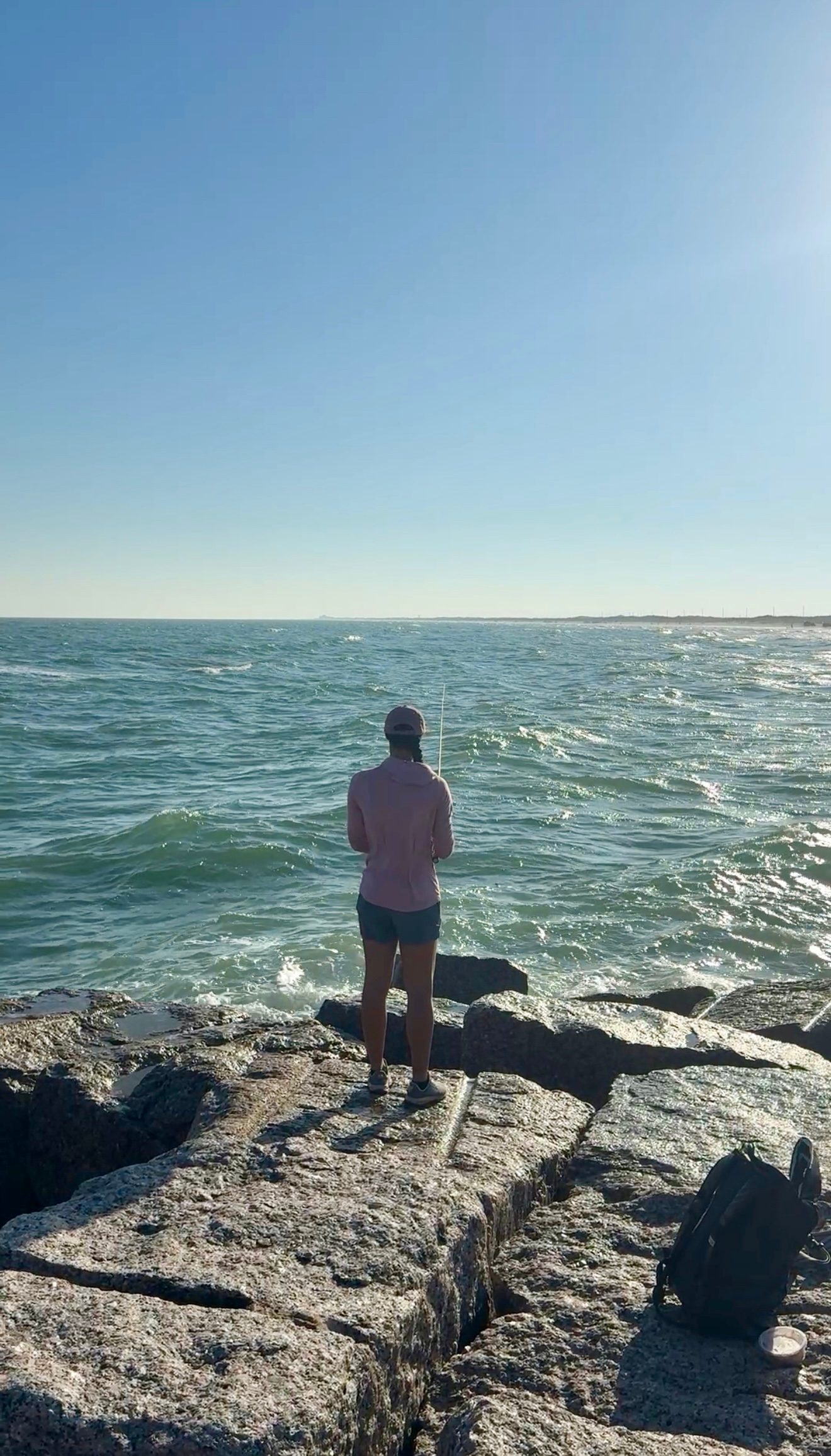
Fishing Saltwater for the First Time
Funded by MAFWA Multistate Conservation Grant
#F25AP00104-00
I’ve spent more hours than I can count on the rivers and lakes in Texas. Freshwater is what I know and where I feel most at home. Even though I grew up at the beach, I didn’t learn how to fish until I was in my 20s, so I didn’t know the first thing about saltwater fishing. This past weekend, I drove over 7 hours to the coast of Texas to see if I could figure out the saltwater bite.
The number of species swimming within casting distance of the shore is unreal, so I went into the weekend with an open mind to catch any one of them. Well, not to spoil the ending for you but after two days of fishing I didn’t catch a single thing. Let me tell you about the weekend and we can debrief about my mistakes so you can learn from them the same way I did!
Day 1 – Fishing the Surf and Jetties
My first full day on the shores of the Gulf I got up before the sun to find the perfect stretch of beach. My goal was to try surf fishing to get my trip started. Surf fishing is essentially just casting from the beach and out toward the waves. Typically surf fishing rods are longer and more heavy duty than a regular bass fishing rod. I didn’t buy any special rods or reels for this trip, though it could have helped. I simply got my heaviest duty rod and reel and did the best I could with what I had.
Before the trip, I had done a ton of research on lures to use, how to fish the surf, best times of day to try, and so on. I had learned that trying to fish in the early morning and early evening were the best times. My research also said I should try to cast past the point where the waves break where fish are congregated. I also read articles that described how to read the waves to find “the trough”. The trough is a word to describe a deeper channel of water between sand bars. Keeping these things I researched in mind, I gathered my gear and headed toward the beach.
When I got down to the shore, I noticed the waves were breaking way farther away than I could cast. That meant I was probably gonna have to go wading a good way before I could make my casts. I was about to start wading when I noticed a lot of jellyfish in the water. I found that every once in a while jellyfish get washed up to shore, and even though they might not be alive, they’re still capable of stinging. That wasn’t ideal. I took the risk and waded to do a little casting. I had to be vigilant as I stood waist deep in the water, but I made it out unscathed!
I fished this way for several hours and I threw all sorts of lures with no luck. I was using artificial lures – jig heads paired with paddle tail soft plastics, spoons, artificial shrimp, and the like. A couple things I think went wrong for me here. I’m not convinced I was getting my casts out far enough. Additionally, I don’t think I had a heavy enough weight to keep my lure in place when I did cast far enough. Wading deeper than I already was would’ve been unsettling because of all the jellyfish. So right before lunch I packed up and made a game plan for a location change.


Later in the day I headed to some jetties to see if fishing the structure would change my luck. I picked up some shrimp from a local tackle shop to put on some circle hooks to use. There were a lot of people already fishing at the jetties, so I didn’t get my choice of locations to fish from. I found a little empty spot between anglers and gave it my best shot.
The wind made my casts a little sketchy, but I made it work. I lost a lot of my shrimp when I was casting. I’d cast and I’d just watch my shrimp chunk go flying into the sunset. I clearly hadn’t perfected how to correctly put bait on the hook just yet. Thankfully, after a few casts I figured out how to securely get my bait on the hook. I saw one fisherman at the very end of the jetty reel in a red fish which was really cool! Other than that, it was a pretty quiet evening and I eventually packed it up and started game planning for the next day.


Day 2 – Hiding from the Wind
The next day I had plans to return to the jetties early to try to get a prime spot at the very end. I saw on the weather app it would be a little windy but I was determined to make it happen. I got up, went to start loading my car and felt the wind blowing a solid 33 miles an hour. It was brutal! And to make matters a little more difficult the wind was blowing toward the shore. Each cast I made hardly went 25-30 feet in front of me even though I put all my power into the cast.
The wind was like a brick wall to my lure and my line was all over the place. I made a change of plans to look for a secluded place away from the wind. I found the “Fish pass” at Mustang Island State Park that was slightly protected. It was still incredibly windy but I’m a little stubborn; I wasn’t going home only having fished one day.
I gave it my all for the second day in a row, but just couldn’t make it happen. I tried a variety of lures and worked my butt off against the wind but just never connected with a fish.


Sometimes all you can say is better luck next time.
While it’s a shame I couldn’t say I caught my first saltwater fish, I had an incredible trip. So many beautiful views were experienced, incredible birds were seen, and unforgettable memories were made. To be very honest, the awful wind was worse for my morale than not catching a fish.
Not catching fish is just part of the journey of being a fisherman. I’m proud of all the new knots and rigs I learned how to tie. I’m also proud of my determination and persistence to keep trying when things weren’t working out in my favor. To me, the puzzle you have to put together to find and catch fish is part of the fun. You take into consideration so many factors – the barometric pressure, weather, season, and so on – to pick the right lure that you then hopefully present in front of a hungry fish. Sometimes it works and it’s a lot of fun! And sometimes it doesn’t work and you go back to the drawing board.
For me, this was a big trip of trial, error, and going back to trial again. This trip I exclusively fished from the bank, but there’s a whole world out there by boat and kayak I need to experience too! There’s still lots for me to learn and I’m eager to get back out there and try again sometime soon.
Saltwater fishing offers so many opportunities to catch unique fish. Here in Texas we are really fortunate to have the opportunity to fish fresh and saltwater. Saltwater requires a different fishing license than freshwater in Texas, so be sure to check out Texas Parks and Wildlife’s website to find the license that’s right for you and your next fishing adventure!

-
Fishing the San Marcos River
On the hunt for the state fish of Texas – the Guadalupe bass!
Funded by MAFWA Multistate Conservation Grant #F25AP00104-00
The Guadalupe bass is a beautiful fish that can only be found in the streams of central Texas. They’re so unique in fact, they have been named the state fish of Texas! As a species, Guadalupe bass are relatively small (especially when you look at their relatives like largemouth bass) – The record for a Guadalupe bass was caught in 2014 at 3.71 pounds according to the Texas Parks and Wildlife website. They live in rivers and streams that don’t allow them to grow the way their other black bass relatives do, but they are just as mighty. Because they live in powerful and fast flowing water, they are incredibly strong fish. And if all that wasn’t enough to be enamored by these little fish, they have a beautiful pattern to boot!
I heard of Guadalupe bass when I first moved to Texas, but because of their limited habitat I hadn’t had the opportunity to go try to find one even though I’ve lived in Texas for nearly 10 years. This past weekend I made a special trip to the hill country just to find one of these special fish. Let me tell you all about it!


To add an extra challenge, I decided to hit the San Marcos river with a fly rod. I’ve only fly fished a couple times in my life before this trip and both times was for trout outside of the state of Texas. I’ve never tried fly fishing for bass, so I figured why not make it a 2 for 1 kind of fishing trip. I had two goals in mind for this trip when I hit the water:
1. Catch a Guadalupe bass
2. Catch any bass on the flyOff the bat, I caught a couple blue gill. It gave me some confidence I was doing the right thing and helped me practice getting a fish in the net before the real deal. There’s nothing more jarring than catching a big ol’ fish on your first cast with no practice, so I’m grateful for the warm-up opportunity.
Throughout the day, I used flies that resembled insects (like grasshoppers and dragonflies), small crawfish, and small baitfish. There’s a lot of water to cover in these rivers and I only had a few hours to try to accomplish my goal, so I was being deliberate with my casts. I was mostly aiming my casts at shade spots, deep pockets of fast-moving water, and lily pads. My casts were anything but pretty, but I was determined to find some bass.
I tried some topwater early without any takers, so I switched to a streamer imitating a minnow. That’s when I got my first bass! And wouldn’t you guess? It was a Guadalupe bass!! I was beyond excited. It had such a beautiful pattern and put up an incredible fight. Two hours into the trip and I could check off both boxes of my two goals!

The San Marcos was a beautiful river to explore. Its spring-fed water was crystal-clear when it was shallow and a beautiful blue in deeper pools. Because it’s spring fed, the water stays relatively cool year-round. As I kept pushing down the river I saw so many fish in the crystal clear water – buffalo carp, gar, catfish, and even common carp! Rumor has it there are even cichlids in this river! It felt like I was in a jungle with all the deep green foliage surrounding the crystal blue water. Texas has a true oasis hiding in these hills.
I caught my fair share of trees and logs throughout the morning. I’d like to blame my lack of skill with a fly rod for all the snags but I feel like it could’ve happened with a conventional set up also. Fishing rivers is tough with all the over hanging trees and submerged structure – getting hung up happens to everyone at some point or another.
About an hour later after making several fly changes I hooked into a much bigger bass – this time a large mouth! On a fly rod, the fight of this largemouth was unreal!

To end the day, I tied on a popper to see if I could get any topwater bites since it was a bust that morning. I caught 4 more bass and one more blue gill on the popper who were all pretty tiny (but a lot of fun none the less).
I really look forward to exploring it again in the future! The fishing was incredible, but the other nature was in full display in the few hours I got to explore the river. Woodpeckers, deer, bald eagles just to name a few of the animals I saw! I think there’s incredible opportunities to both wade and kayak this awesome river again sometime really soon!
The good news in Texas is that your standard fresh water fishing license will cover you in these river systems – no extra licensing required! If you’re ready to tackle the world of fly fishing, remember to grab your Texas fishing license, muster up some patience, and go explore the wonderful rivers in this beautiful state! You won’t regret it!
-
Shooting Docks for Crappie
Funded by MAFWA Multistate Conservation Grant #F25AP00104-00
While docks are a great place to find crappie year-round, in the spring and fall crappie can suspend under docks by the dozens. The docks act as great cover from predators and the harsh sun. Additionally, the docks are full of baitfish that the crappie can snack on! The technique of shooting docks involves using small lures to imitate these snack sized bait fish and shooting them deep under docks right under the nose of a hungry crappie.
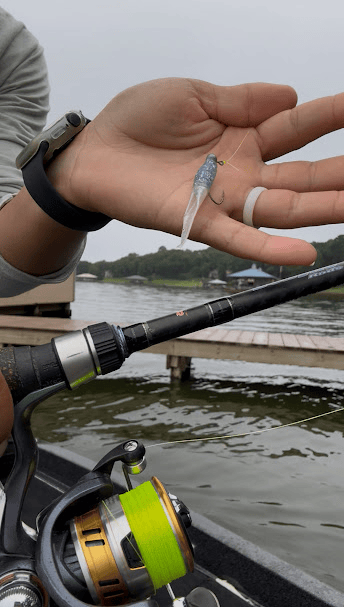
When you are shooting docks, you want to use a small light lure. Sometimes it is believed that a flat lure can skip just a little bit better than others, but most jigs with a soft plastic trailer will do the trick. You’ll want a rod with some backbone to it so that when you go to “slingshot” the bait, the rod can snap back into its normal position with ease.
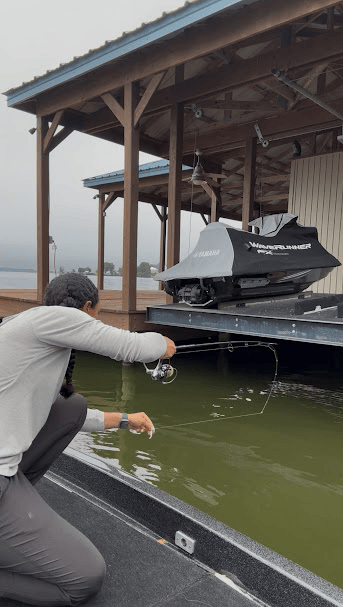
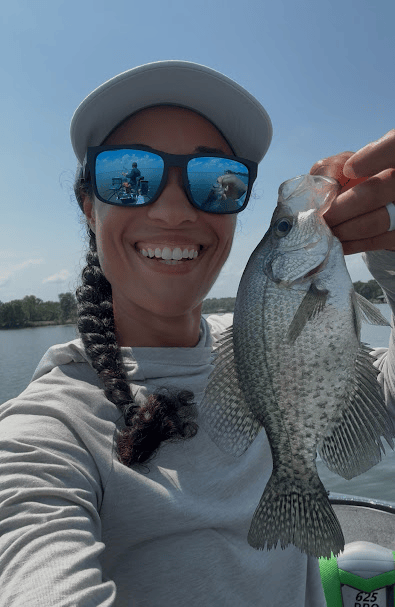
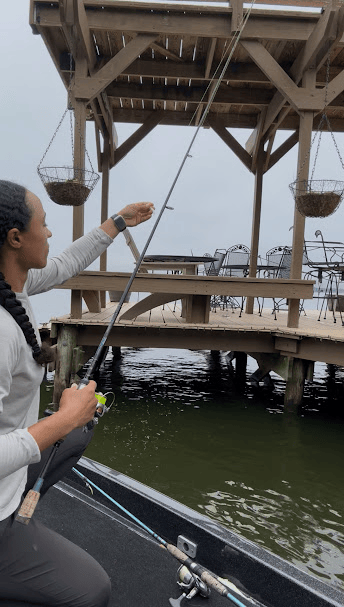
This was my first time shooting docks and I had a lot to learn. Getting that bait to skip wasn’t as easy as I initially thought. I watched my friend do it and he made it look so simple! My first couple attempts weren’t pretty.
Here’s a few things I learned that made the skipping part of dock shooting a little easier on me.
- Hold the jig head between your fingers. Pull the lure back far – down by the butt of the rod. Aim the rod where you want the lure to go, and let go. Try your best to go as parallel as you can to the water to help the skipping capability. If your aim is too perpendicular to the water it’ll just make a big splash.
- Only have enough line out so that the lure is level with the rod eye closest to the reel. At first, I had way too much line out so when I tried to slingshot it, it had no velocity and kind of splatted in the water right in front of me. It wasn’t skipping at all. Less line out and really pulling the lure back made a huge difference in the distance of each pitch.
- It can be helpful to use line that you can easily see. Sometimes the crappie bite pretty subtly, so watching your line for any sudden movement could be key to catching finicky fish.
- For me, the crappie I caught all hit on the fall. Once I got the jig under the dock, I’d let it fall and I’d get the bite – but this isn’t always how it goes. Sometimes some jerks to the lure do some good. Other times slow reeling with pauses is the way to go. Mix it up if you aren’t getting any bites.
It took me quite some time to get the hang of the action of shooting the lure deep under the docks, but it was a fun afternoon on Lake Palestine! Keep in mind, getting lures deep under docks comes with a few snags. There’s often debris, posts, and even whole brush piles under docks that you simply can’t see that you’ll get tangled in. This is to be expected! Don’t be too hard on yourself for getting stuck every now and again. It’s all part of fishing docks. Ask me how I know. I learned a lot on the water today and found a crappie along the way! I was shooting docks from a boat today, but I’d love to try this from my kayak sometime soon. I’ll be sure to update y’all on any differences I notice between shooting docks from a boat and kayak. If you’ve never had the opportunity to shoot docks, I highly recommend giving it a try! Pick up your Texas fishing license, give yourself time to practice, and then just go for it!


